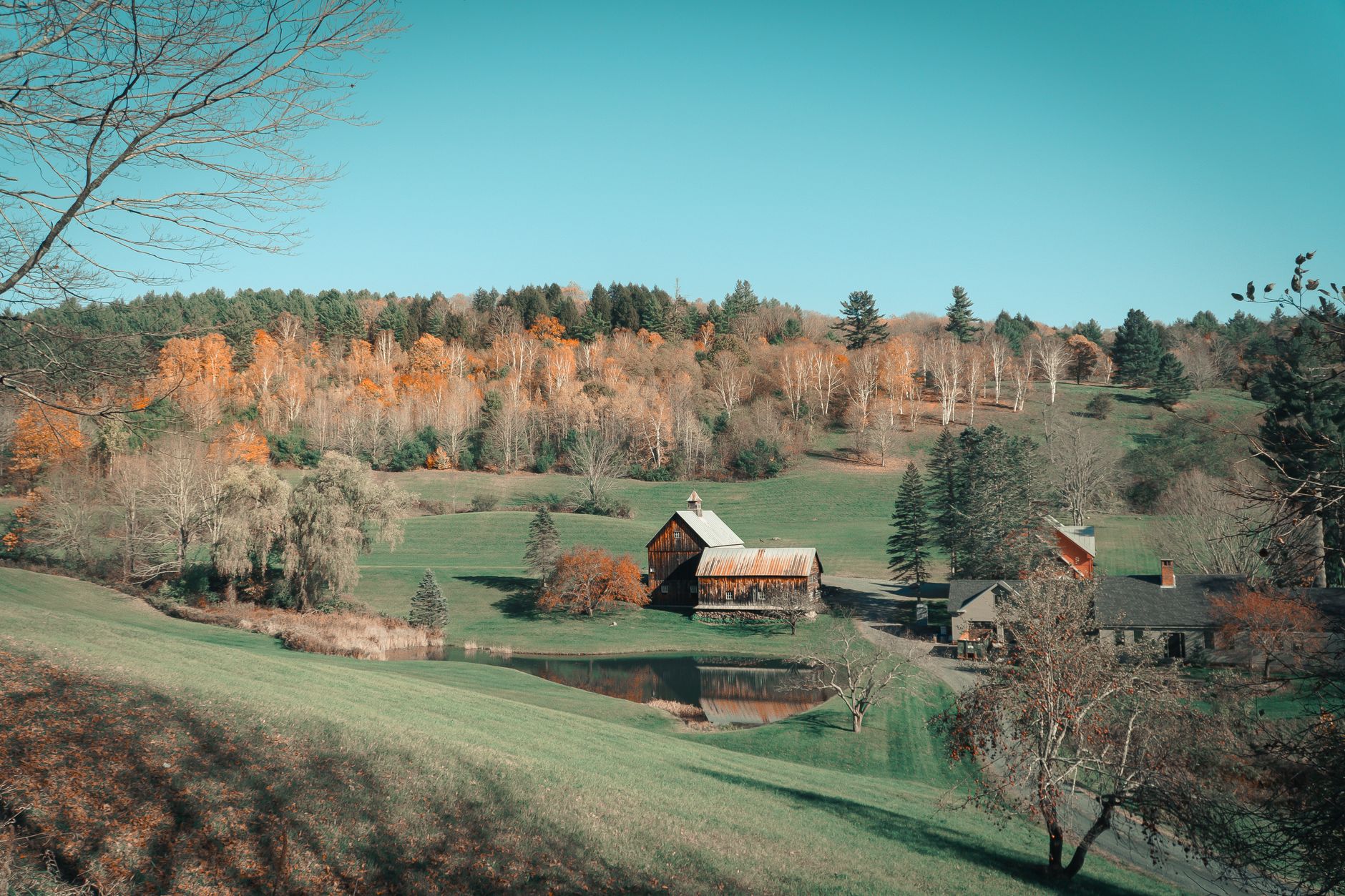
The model village
Woodstock is frequently described as the prettiest small town in America, and unlike most places carrying that label it has actively earned it. Founded in 1761 and chartered as the shire town of Windsor County, it grew as a prosperous county seat of lawyers, printers and merchants, which left it a downtown of unusually fine Federal and Greek Revival brick and clapboard architecture.
What preserved that architecture was a century of deliberate stewardship rather than luck. Where most American towns modernized hard after the Second World War, Woodstock did the opposite: strict zoning, an active historical society, and the sustained patronage of Laurance Rockefeller and his wife Mary French Rockefeller — granddaughter of the railroad magnate Frederick Billings — funded restoration, bought threatened buildings and, in the 1960s, paid to bury the overhead utility wires so the streetscape would read as it had a century earlier.
The result is a village with no visible power lines, no neon signage and no chain retail in its core, arranged around a wide oval green. It is small — under 3,000 people in the town, and only a few hundred in the village proper — and it can be walked end to end in fifteen minutes, which is exactly how it should be seen.
The Green and the covered bridges
The Village Green is the organizing fact of Woodstock: a tree-shaded oval ringed by white-clapboard and brick houses, the 1807 Congregational church, the Norman Williams Public Library and the white-picket Woodstock Inn & Resort. Benches, brick sidewalks and gas-style lamps complete it, and on summer evenings it fills with people doing nothing in particular.
Crossing the Ottauquechee River at the north-east corner of the green is the Middle Covered Bridge, a 139-foot lattice-truss span built in 1969 to replace a failed 19th-century structure — a rare case of a covered bridge being built in the modern era using traditional methods. It carries traffic and a separate pedestrian walkway, and the view upriver from inside it is the town’s signature photograph.
Two more covered bridges sit within a few miles. The Taftsville Covered Bridge, built in 1836 and the third-oldest in Vermont, is a striking red-timber span east of town over a roaring gorge, using a rare modified kingpost truss. The Lincoln Covered Bridge, west of town and built in 1877, is the only remaining wooden Pratt truss bridge in North America, spanning 136 feet.
Around the green, Elm and Central Streets hold the shops: F.H. Gillingham & Sons, a general store trading since 1886, with creaking wooden floors, Vermont maple syrup, artisan cheeses, cookware and wine; the Woodstock Bookshop; and a run of galleries, clothiers and antique dealers.
Billings Farm & Museum
Half a mile north of the green on Route 12, Billings Farm & Museum is one of the premier working dairy farms and agricultural museums in the United States, and it is the reason Woodstock feels connected to the countryside rather than sealed off from it.
Frederick Billings established it in 1871 as a model farm, importing Jersey cattle from the Isle of Jersey to demonstrate scientific breeding and sustainable practice to a Vermont whose hillsides had been stripped by sheep farming and clear-cutting. The herd descends from those imports and is still milked twice daily.
Visitors get a genuinely working farm plus a museum. The 1890 farm manager’s house is restored to the period, complete with creamery and kitchen garden; interactive exhibits cover 19th-century Vermont farm life; and the barns hold draft horses, Southdown sheep, heritage pigs, goats and calves that children can meet. Cow-milking demonstrations run daily at 3:30pm, and there are tastings of raw-milk cheddar made on site.
Admission is roughly 17 dollars for adults and 10 for children, open May through October with seasonal winter programming, including sleigh rides when there is snow.
Vermont’s only national park
Directly across Route 12 from the farm sits Marsh-Billings-Rockefeller National Historical Park — Vermont’s only national park unit, and the only unit in the entire National Park System dedicated to conservation history and land stewardship.
Three generations shaped the 550-acre estate. George Perkins Marsh was born on the property in 1801 and wrote Man and Nature in 1864, the first book to argue systematically that human activity was degrading the earth, and effectively the founding text of American conservation. Frederick Billings bought the depleted land in 1869 and planted one of the first planned scientific forests in the country, much of which still stands. Laurance Rockefeller, who married Billings’s granddaughter Mary French, donated the mansion, gardens and forest to the American public in 1992.
The Queen Anne-style brick mansion is open by guided tour and holds an exceptional collection of Hudson River School landscape painting, including Bierstadt and Church — an appropriate gallery for a house built by conservationists. The Carriage Barn Visitor Center covers the estate’s history and the origins of the conservation movement.
Behind the mansion, twenty miles of gently graded gravel carriage roads climb Mount Tom through mature hemlock and pine. A 1.5-mile walk reaches The Pogue, a still, dark 14-acre pond ringed by forest; continue to the South Peak of Mount Tom, about 1,350 feet, where an open rocky ledge looks straight down over the green, the covered bridges and the river. The grounds and carriage roads are free; only the mansion tour is ticketed. In winter the Woodstock Nordic Center grooms the carriage roads for cross-country skiing.
Eating, drinking and the seasons
Woodstock’s food runs on Windsor County farms, and it punches well above the town’s size.
The Red Rooster — the Woodstock Inn’s dining room, farm-to-table fine dining drawing on the resort’s own three-acre organic Kelly Way Gardens.
Richardson’s Tavern — the inn’s cosy fireside pub, with local craft taps and Vermont cheese fondue.
Mon Vert Cafe — organic French-inspired coffee house on Central Street: avocado toast, goat cheese paninis, maple lattes and quiches.
The Village Butcher — a classic counter on Elm Street for thick deli sandwiches to eat on the green.
Woodstock Farmers' Market — a year-round indoor gourmet food hall west on Route 4, with a custom deli, cheese counter and local produce.
Wassail Weekend, mid-December — the village’s Victorian holiday festival, with a horse-drawn parade, carollers and candlelit shops.
Foliage, 1 to 12 October — peak colour in the river valley, and the busiest fortnight of the year.
Beyond the village
Woodstock works best as a base rather than a single stop, and the rest of Windsor County is close.
Quechee is eight miles east on Route 4: Quechee Gorge, Vermont’s deepest at about 165 feet, viewed free from the bridge sidewalk or by a 1.4-mile trail to the river, and the Simon Pearce glassworks in a hydro-powered 19th-century mill above the falls, with live glassblowing and a restaurant over the water.
Plymouth Notch is thirty minutes south-west: an entire 19th-century village preserved as the President Calvin Coolidge State Historic Site, where Coolidge took the oath of office by kerosene lamp at 2:47am on 3 August 1923, plus Plymouth Artisan Cheese, founded by his father in 1890.
South on Route 106 lies Jenne Farm in Reading, among the most photographed farms in North America — red barns in a dip of pasture, best at sunrise in October. Killington and Okemo are both within forty minutes for skiing, Windsor and the 449-foot Cornish-Windsor Covered Bridge are twenty-five minutes south-east, and Hanover, Dartmouth College and the free Hood Museum of Art are half an hour east.
Practical information and where to stay
Woodstock sits on US Route 4, 88 miles and about ninety minutes south-east of Burlington via I-89 to Exit 1, and 140 miles from Boston. The village core is exceptionally walkable, but a car is needed for Quechee, Plymouth Notch and the trailheads. Metered parking rings the green, with free lots behind Town Hall and at the east end of town.
The landmark stay is the Woodstock Inn & Resort on the green: established in 1892, rebuilt by Laurance Rockefeller, with wood-burning fireplaces, a 10,000-square-foot LEED-certified spa, an 18-hole Robert Trent Jones Sr. golf course and its own organic farm. Rates run roughly 420 to 850 a night.
Below that, historic village inns and B&Bs run 220 to 380 — the Shire Woodstock on the riverfront, the 1890 Village Inn of Woodstock — and value options along Route 4 near Quechee start around 175. Quechee State Park offers camping. Compare live prices in the search below, with free cancellation on most rooms.
Good to know
Common questions
Why is Woodstock called the prettiest town in America?
Because it was preserved rather than modernized: strict zoning, an active historical society and Rockefeller patronage funded restoration and buried the utility wires in the 1960s. The core has no visible power lines, no neon and no chain retail, arranged around a wide oval green.
What is Billings Farm & Museum?
A working Jersey dairy founded by Frederick Billings in 1871 as a model farm, plus an agricultural museum. The herd descends from cattle imported from the Isle of Jersey and is still milked twice daily, with public demonstrations at 3:30pm, a restored 1890 farmhouse and raw-milk cheddar tastings.
What can you do at Vermont’s national park?
Tour the Queen Anne mansion and its Hudson River School paintings, and walk twenty miles of 19th-century carriage roads up Mount Tom — a 1.5-mile climb to The Pogue, a 14-acre forest pond, and on to the South Peak ledge above the village. The grounds are free; only the mansion is ticketed.
How many covered bridges are in Woodstock?
Three within a few miles: the Middle Covered Bridge on the green, built 1969 with traditional methods; the 1836 Taftsville Bridge east of town, Vermont’s third oldest; and the 1877 Lincoln Bridge west of town, the only wooden Pratt truss bridge left in North America.
When should I visit Woodstock?
Foliage peaks between about 1 and 12 October and is the busiest fortnight of the year. Summer suits Mount Tom and the farm; mid-December brings Wassail Weekend, a Victorian festival with a horse-drawn parade; and winter grooms the carriage roads for cross-country skiing.
Every booking through Vermont Destinations funds one verified tonne of carbon removal — same room, same price, no markup.
Find a stay